Neo4j MPGNN Thesis/ Page 3 of 5
Inference Strategies
Comparing four inference strategies: full graph loading, neighborhood sampling, in-database Cypher queries, and in-database Java execution for GNN inference.
We benchmarked four different strategies for running inference with a trained GNN model, ranging from loading the entire graph into memory to running inference entirely inside the database.
1. Full Graph (Baseline)
The simplest approach: load the entire graph into RAM and run the forward pass in Python using PyTorch Geometric.
How it works:
- Fetch all nodes, edges, and features from Neo4j at startup
- Store in PyG’s in-memory
Dataobject - Run standard PyG inference
Pros:
- Fastest inference (no database queries during inference)
- Simple implementation
Cons:
- Requires enough RAM to hold the entire graph
- Not feasible for very large graphs (e.g., ogbn-papers100M)
This serves as our baseline for accuracy and speed.
2. Neighborhood Sampling
Instead of loading the full graph, fetch only the k-hop neighborhood for each node being inferred.
How it works:
- For each target node, query Neo4j for its k-hop subgraph
- Build a mini-graph and run the forward pass
- Aggregate results
Pros:
- Much lower memory usage
- Scales to larger graphs
Cons:
- Slower due to database queries
- Approximate (depends on sampling strategy)
3. In-Database Cypher Inference
Run the entire inference pipeline inside Neo4j using Cypher queries.
How it works:
- Express the GNN forward pass as a series of Cypher queries
- Neo4j computes node representations layer by layer
- Return final predictions
Pros:
- No data transfer between database and application
- Can leverage Neo4j’s query optimization
Cons:
- Requires float features (
embedding_bytes_floats), which are slower for training - Limited by Cypher’s expressiveness
4. In-Database Java Inference
Use the custom Java UDP plugin to run inference inside Neo4j.
How it works:
- Deploy the trained model to Neo4j as a Java procedure
- Call the procedure from Cypher to run inference
- Model runs in the JVM inside Neo4j
Pros:
- Minimal data transfer
- Faster than Cypher-based inference
- Can use optimized byte-array features
Cons:
- Requires building and deploying the Java plugin
- More complex setup
Comparison
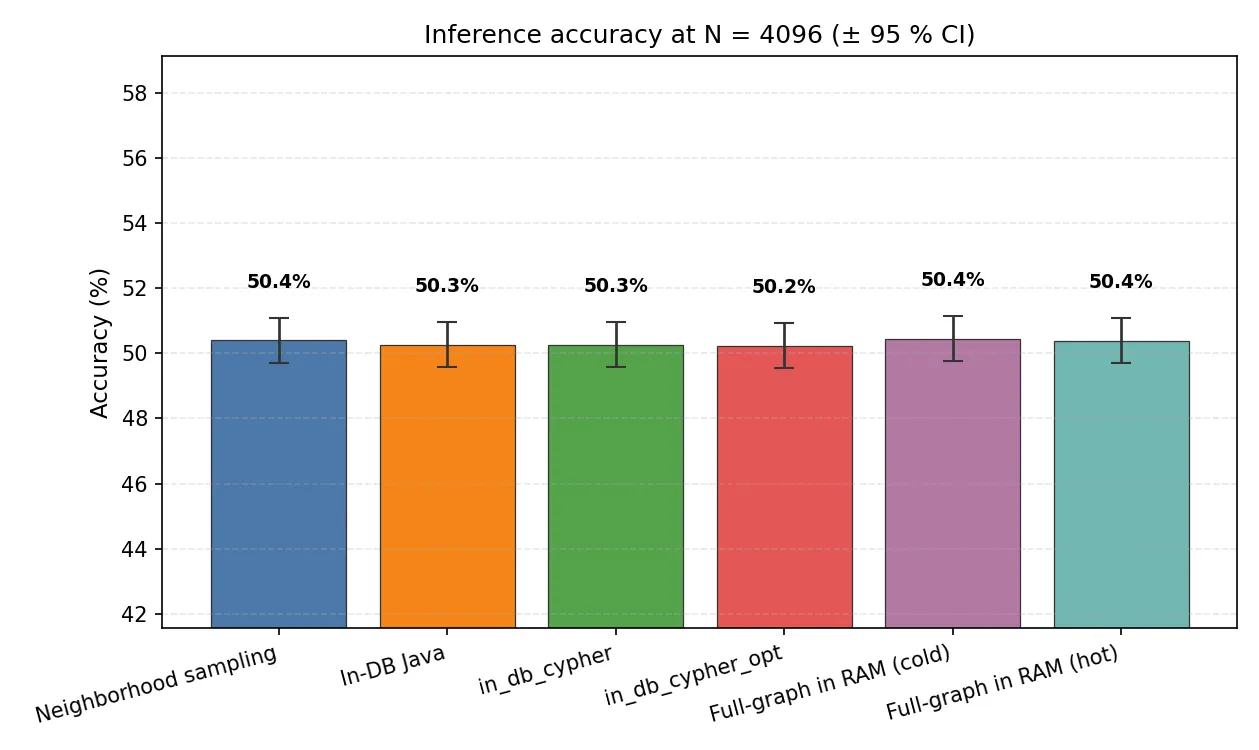
All four methods produced statistically indistinguishable accuracy on our benchmark datasets. The key differentiator was speed and resource usage:
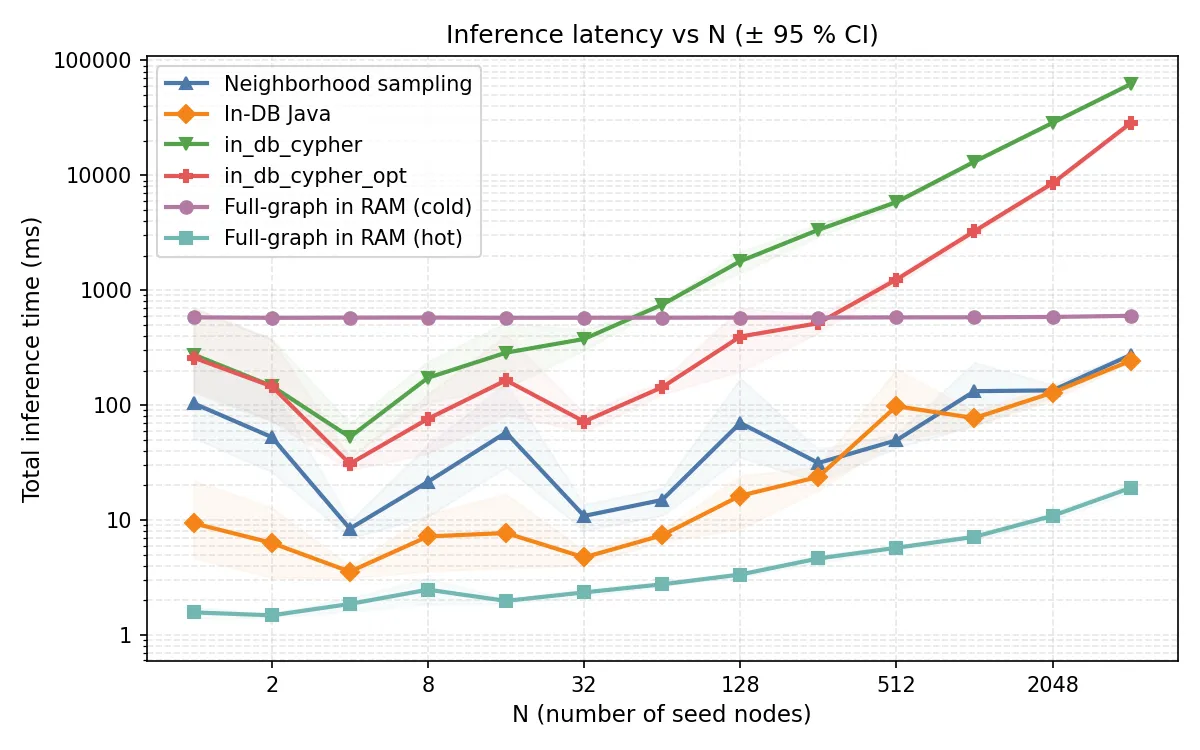
- Full graph: Fastest but highest memory
- Neighborhood sampling: Lower memory but slower
- In-database Cypher: Moderate speed, requires specific feature format
- In-database Java: Best balance of speed and memory for large graphs