Neo4j MPGNN Thesis/ Sida 4 av 5
Training Strategies
Benchmarking training approaches: baseline PyG sampling, Java UDP plugin optimization, pre-aggregation, and GraphSAINT subgraph sampling for GNN training.
Training GNNs on graph databases introduces unique challenges. We benchmarked several strategies to understand the tradeoffs between speed, memory, and accuracy.
Baseline: PyG with Neo4j Sampling
The standard approach: use Neo4j as the data source, but perform training in Python with PyTorch Geometric.
How it works:
- Sample k-hop neighborhoods from Neo4j using Cypher queries
- Fetch node features and labels
- Run training step in PyG
Pros:
- Simple, uses standard PyG training loops
- Flexible sampling strategies
Cons:
- High data transfer between Neo4j and Python
- Can be slow for large graphs
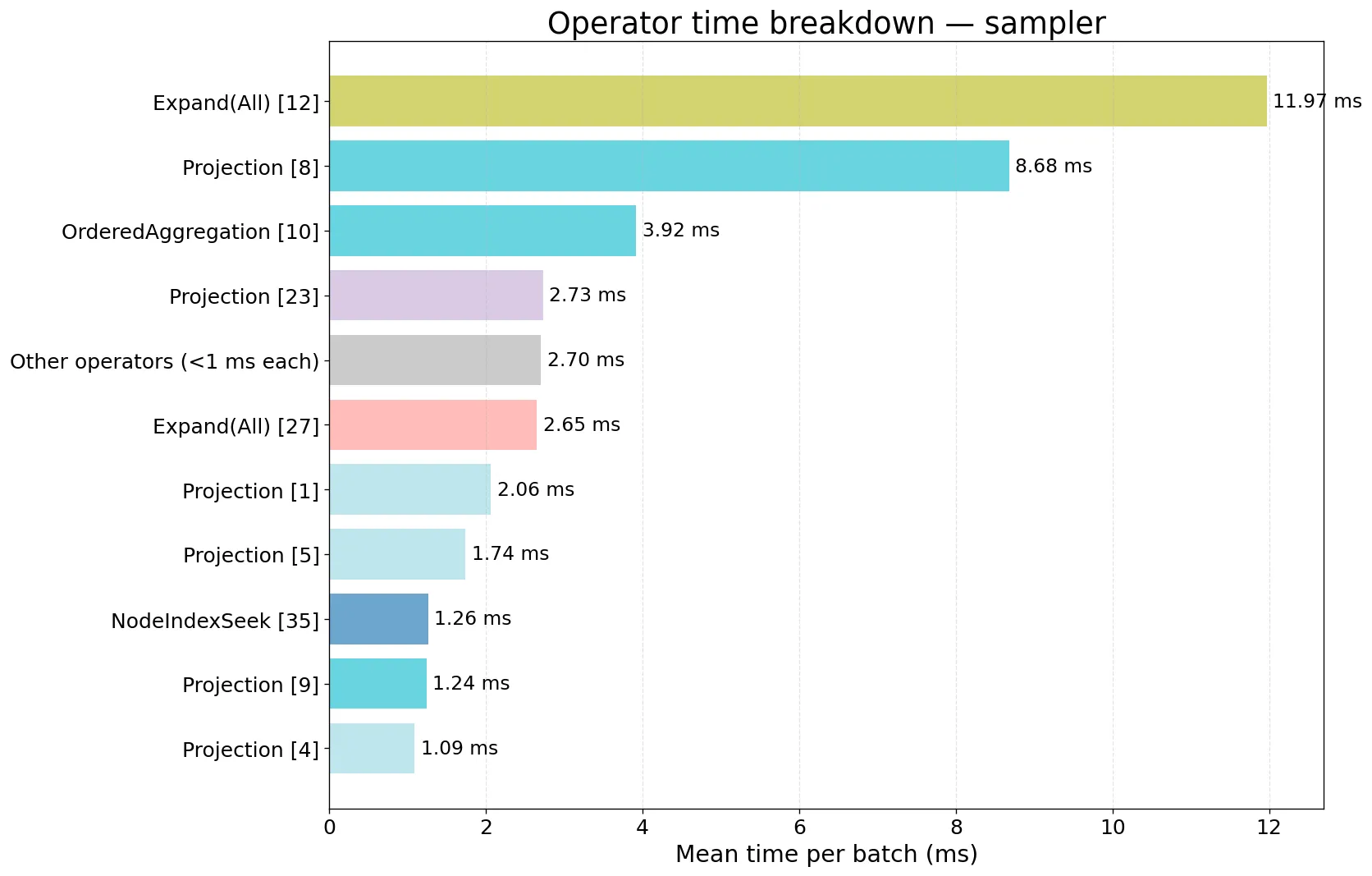
Profiling the Cypher sampler revealed that operators like Expand and Projection dominate the per-batch time:
Java UDP Sampling
Use the custom Java plugin for sampling instead of Cypher queries.
How it works:
- Call the Java sampling procedure from Python
- Fetch compact byte-array features
- Train in PyG
Pros:
- Faster sampling (optimized Java code)
- Reduced data transfer (byte arrays vs. floats)
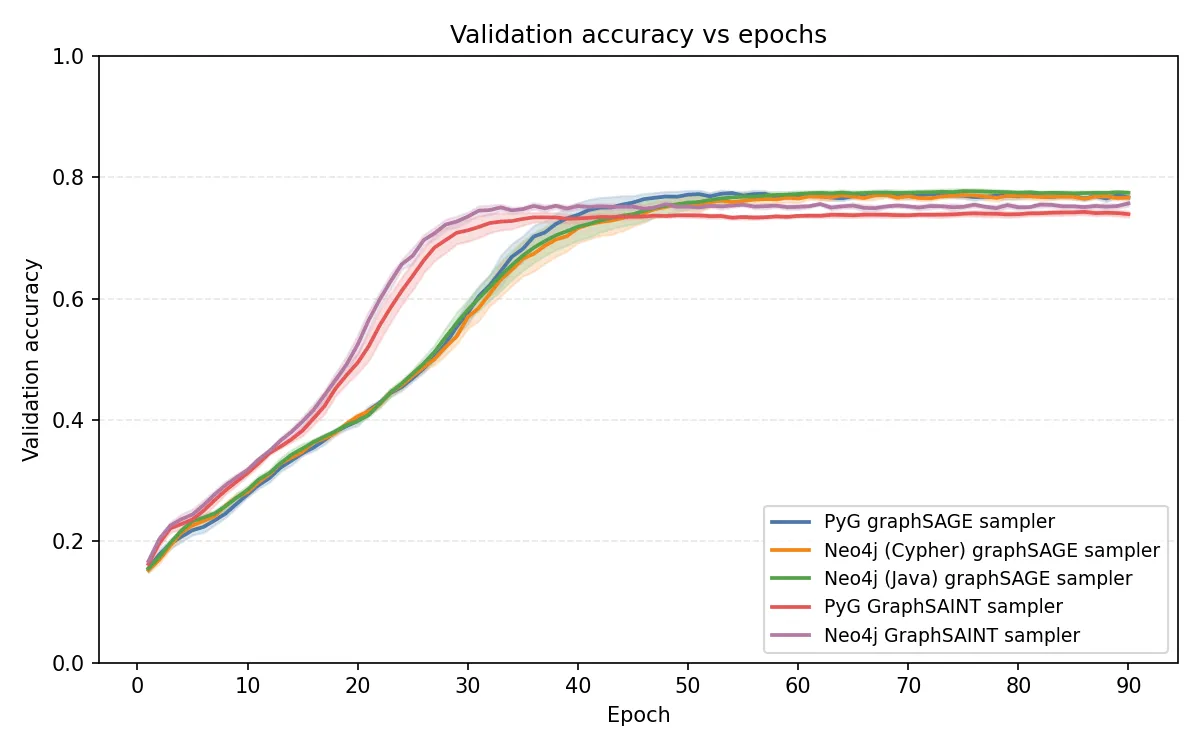
- Statistically identical accuracy to baseline
Cons:
- Requires building and deploying the Java plugin
Critically, the Java UDP sampler achieves the same validation accuracy as PyG’s native sampler and the Cypher-based approach:
Pre-aggregation
Pre-compute aggregations to speed up training.
How it works:
- Pre-compute aggregated messages for each node
- Store pre-aggregated features in Neo4j
- Training uses pre-computed values
Pros:
- Faster training (less computation per step)
Cons:
- Requires pre-processing step
- Less flexible (aggregation is fixed)
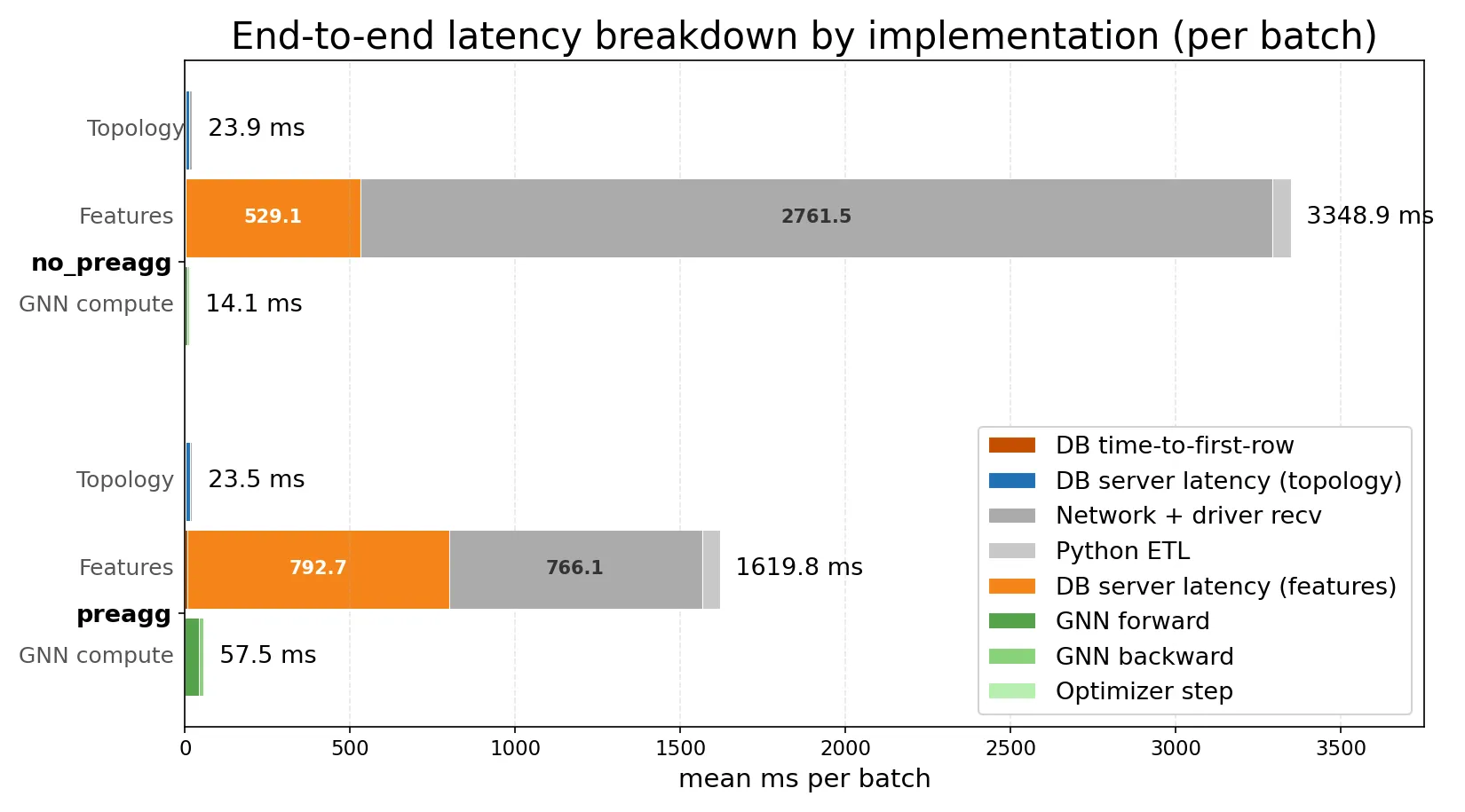
Pre-aggregation shows the most benefit on high-dimensional feature vectors (Coauthor Physics, 4,993 dims), where feature fetch latency dominates:
GraphSAINT
GraphSAINT is a sampling strategy that samples subgraphs rather than individual neighborhoods. We compared Neo4j and PyG implementations.
How it works:
- Sample entire subgraphs from the graph
- Train on subgraphs instead of individual neighborhoods
- Reduces redundancy in sampling
Pros:
- More efficient sampling for some graph structures
- Can reduce training time
Cons:
- More complex implementation
- May not suit all graph types
Key Insights
-
Java UDP sampling was significantly faster than Cypher sampling while maintaining identical accuracy. The reduced data transfer (byte arrays) was the main factor.
-
Feature format matters: Using
embedding_bytes(byte arrays) was ~2x faster thanembedding_bytes_floatsfor training. However, in-database Cypher inference requires float features, creating a tradeoff. -
Pre-aggregation can speed up training but reduces flexibility. It’s a good option when the aggregation strategy is fixed and the graph is static.
-
GraphSAINT showed promise but required careful tuning of subgraph size and sampling strategy.
Scalability
The Java UDP approach scaled best to large graphs. On ogbn-papers100M (111M nodes), the Cypher-based approach was prohibitively slow, while the Java plugin made training feasible on modest hardware:
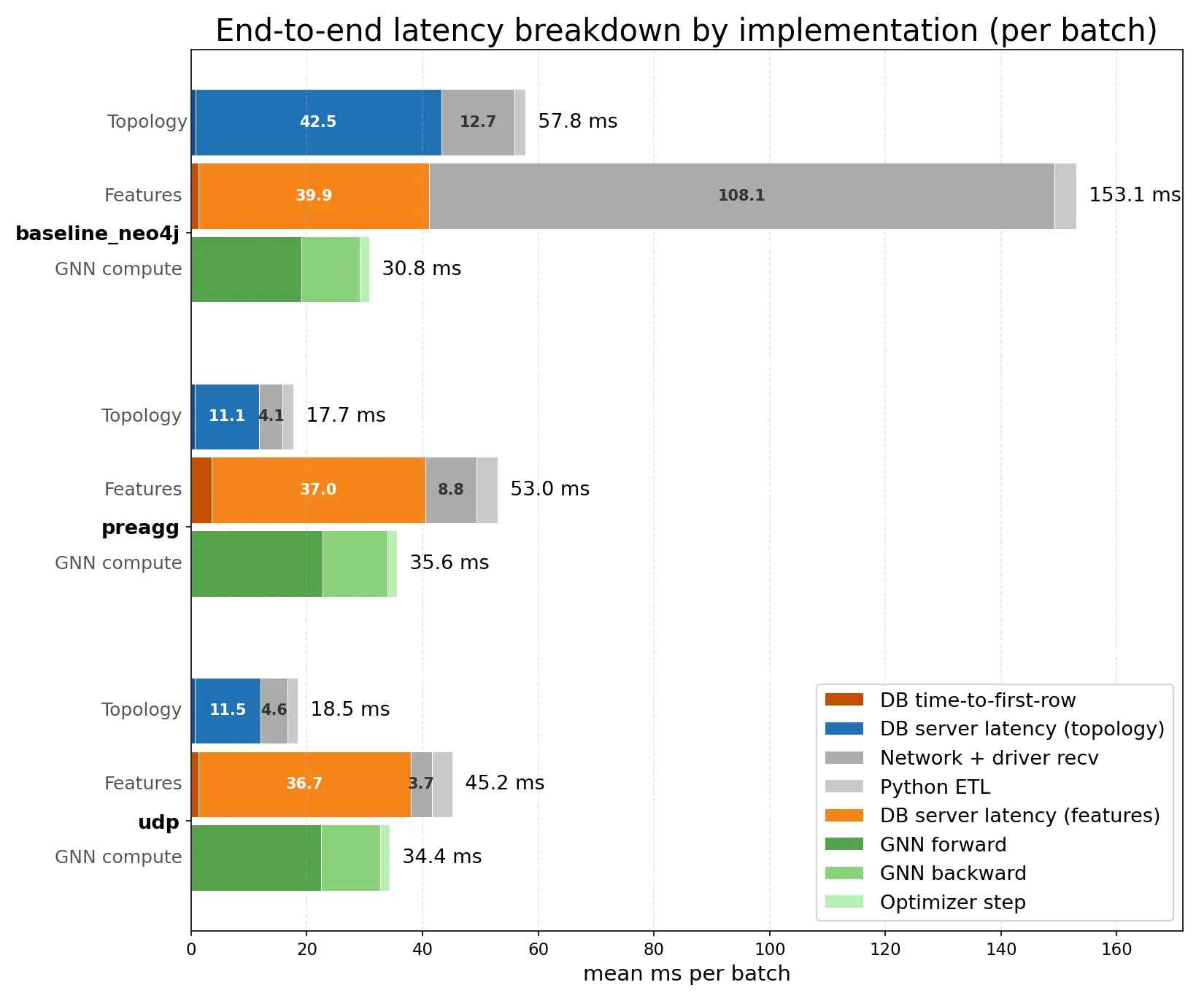
The chart shows that the baseline Neo4j approach spends 153ms per batch (mostly on feature fetching), while the UDP approach cuts this to 45ms, achieving a 3.4x speedup.